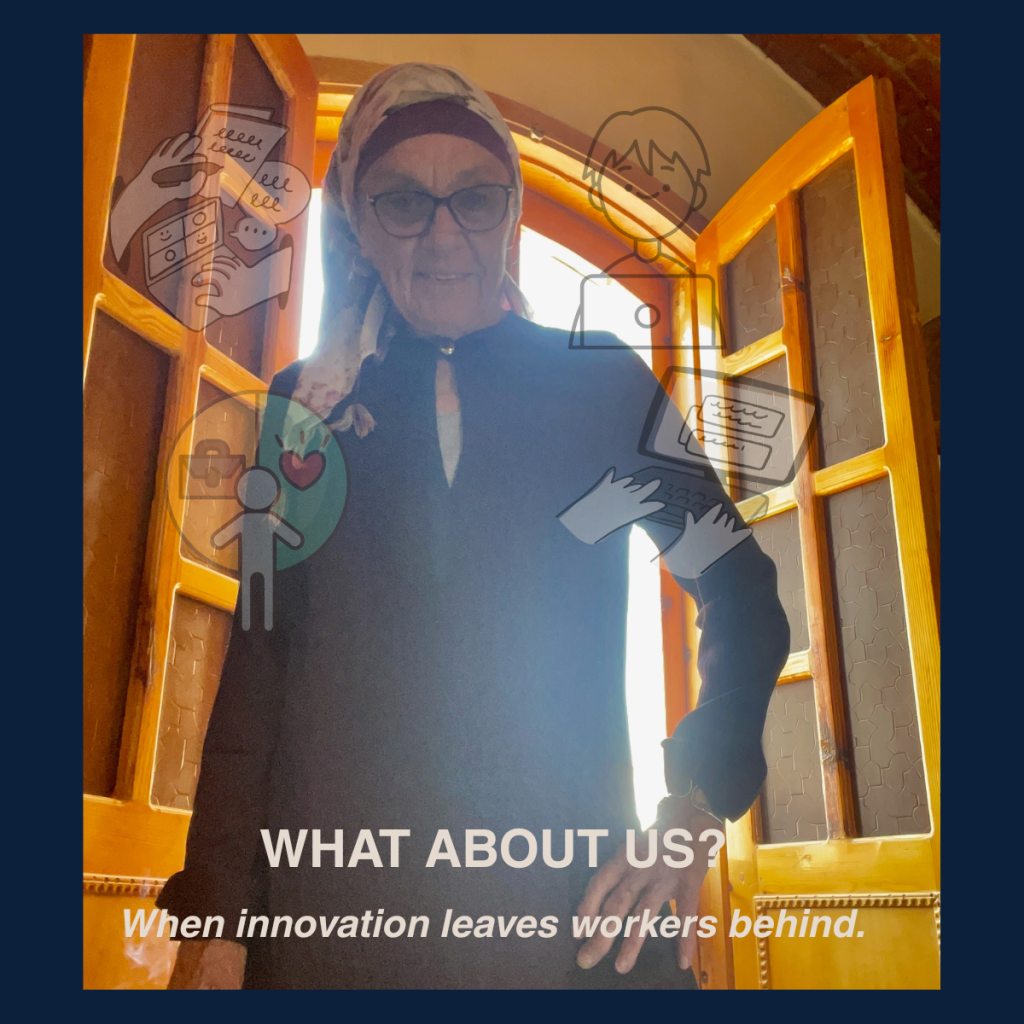
What about workers who have spent years building careers that now seem to be evaporating in the name of “innovation”?
This has been on my and others’ minds lately.
We continue to see the same pattern in all fields and roles: tech workers, freelancers working as translators, editors, designers, teachers, and other knowledge workers being pushed out, replaced, or told to “pivot” into new roles that almost always pay much less than they were making.
One story, especially, was CNN’s report on Timothy McKeon, a rare Irish-language translator who told them he had lost about 70% of his income after AI tools reduced demand for his work. (See my post, “Don’t Feed the Machine.”
That’s not just a career change. It’s a major financial shock to a real person.
And he’s not alone.
Here are a few stats that show the bigger picture:
- About 40% of global employment is exposed to AI, according to the IMF.
- The World Economic Forum projects 92 million jobs displaced and 170 million new jobs created by 2030.
- A 2024 survey found 36% of translators had already lost work to generative AI, and 43% reported lower income.
- Global tech layoffs reached about 244,851 in 2025.
Yes, new jobs are being created. But most of them are low-paid, AI-adjacent roles: editing machine output, cleaning up errors, checking quality, and doing work that is usually valued less than the human expertise it replaced.
At the same time, some hiring trends are leaning toward service roles tied to comfort, convenience, and wealth: concierge-type work, private household assistance, personal care, and other jobs that serve the affluent.
So while middle-class knowledge work is being compressed, other parts of the labor market are growing in directions that tell us a lot about what is valued in our current world.
And it matters because when middle-income workers lose stability, the effects ripple outward.
People travel less. They spend less. They cut back on leisure, services, dining, and everything else that depends on ordinary purchasing power.
A weaker middle class is not limited to a single industry.
If there is a hopeful thread here, it’s that not everyone sees AI as a replacement machine.
@Joachim Lépine’s new book, YouGPT Before ChatGPT, presents an ethical, human-centered approach to AI, keeping people at the center rather than making them disposable.
This is why I ask: What about us?
Let’s start speaking up and asking: what about the workers whose livelihoods are being compressed, downgraded, or erased while the conversation continues to focus on innovation?
I’m not writing this out of bitterness. I’m writing it out of concern.
We need to talk honestly about the human cost of these transitions, because the economy is not just code, platforms, and automation. It runs on people, families, and the ability to keep a middle-class life afloat.
What about ALL of us when the work disappears?


Leave a Reply