
I’ve worked in translation for a long time.
I’ve learned that language professionals are everywhere: email, WhatsApp groups, professional associations, virtual conferences, and, of course, on LinkedIn.
So when the new forum moderator showed up at an agency where I’ve worked for years, I did what I usually do.
I searched for her on LinkedIn.
I’ll call her Tryna.
I had received replies from her in support emails and saw her interactions on the translators’ forum. They were extremely polished, detailed, and written in such perfect English, which was a big change from the one- or two-line responses from previous moderators.
The kind of English that made me wonder if she’d been trained by a customer-service manual, a corporate communications department, and an Oxford comma enthusiast.
I couldn’t find Tryna on LinkedIn.
So I asked a completely innocent question in the forum:
“I was trying to find you on LinkedIn, as I do with everyone here, but couldn’t. Do you have a LinkedIn profile? If so, would it be okay for us to connect?”
Here’s where the story gets weird…and funny.
My Invitation Becomes a Support Ticket
Instead of replying with something like:
“No, I’m not on LinkedIn, but thank you!”
She gave a very formal response explaining that, “for account-related questions, requests, and support matters, I should contact the support team by email through the official channel.”
There was gratitude for my message.
There was appreciation for my interest.
There was a reminder that the appropriate team could assist me more efficiently.
Everything except an answer to the question: “Are you on LinkedIn?”
By then, one of my colleagues piped up with what may be the finest translation of human intent I have ever heard.
Rodrigo said he didn’t want to put words in my mouth, but he was fairly sure my intention was simply to connect outside the platform:
“You know, like humans used to do, and form some kind of bond beyond the sterile confines of strictly work.”
I want to frame that sentence and hang it above my desk.
The Big Question
Another colleague then asked what everyone had begun to wonder:
“What are the odds that we’re actually speaking with an AI agent right now?”
Rodrigo replied:
“Not zero, most likely.”
And suddenly, the tone of the conversation changed.
The next day, Tryna responded with a lengthy message beginning with:
“First of all, I’d like to reassure you that this is not an AI agent. I’m a real person.”
Now, I want to be fair.
A real person can write a long, carefully worded message.
A real person can choose not to use LinkedIn.
A real person can have strong opinions about privacy, formal support channels, appropriate teams, contributor forums, and the proper handling of personal contact information.
That’s all possible.
But there is also something inherently funny about a group of translators asking, “Are you a bot?” and receiving a multi-paragraph response that sounds like it was generated by a bot whose primary job is to reassure people that it is not a bot.
Especially when the original question was: “Would you like to connect on LinkedIn?”
The Last Message from Tryna
Tryna posted again a few days later.
Then nothing.
No more detailed support messages.
No more diplomatic forum replies.
No LinkedIn profile.
No connection request.
No farewell.
Maybe Tryna was reassigned.
Maybe she took a well-deserved vacation.
Maybe she is a real person who’s just had enough of a forum full of translators examining her writing style for signs of AI Slop. 😂
Or maybe our little group of language professionals did what translators do best.
We noticed the words.
We noticed the tone.
We noticed that the answer didn’t quite match the question.
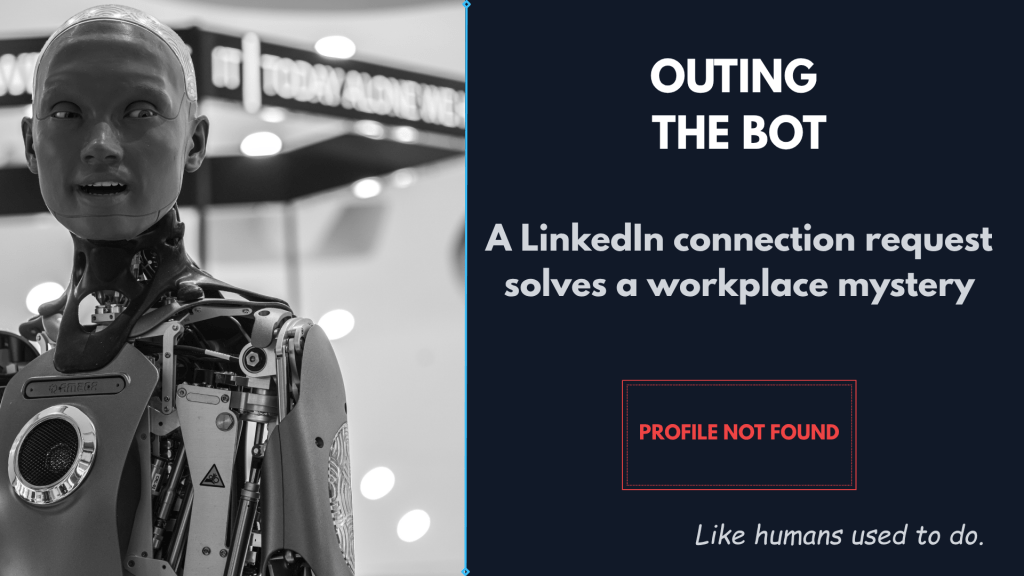
We may have accidentally outed the bot with a LinkedIn connection request.
In the end, the lesson is simple: never underestimate a forum full of translators when they read a suspiciously polished paragraph.
* I never received confirmation of whether Tryna was human, automated, or some combination of both, so this is a story about appearances, language, and the peculiar comedy of modern workplace communication. It is not a factual claim about anyone’s identity.


Leave a Reply